Thursday, September 5, 2013

A Word with Amalia Cochran, MD, MA, FACS, FCCM about Twitter

by Heather Logghe, M.D.

Dr. Amalia Cochran serves as Secretary for the Association of Women Surgeons and is a member of the American College of Surgeons Professional Association Political Action Committee Board of Directors. She chairs the Education Committee of the American Burn Association, is Vice Chair of the Undergraduate Medical Education Committee of the Society for Critical Care Medicine, and is a member of the Association of Academic Surgery Education Committee. She is also the Chair of the Multi-institutional Education Research Group of the Association for Surgical Education. 

Her research interests lie in the areas of education and clinical outcomes, and she has been the recipient of numerous teaching awards. Dr. Cochran is a burn surgeon at the University of Utah School of Medicine.

In addition to all of Dr. Cochran's accomplishments, she serves as a leading voice in health care social media. In today's post, Dr. Cochran discusses her growing use of Twitter.
 
Q: What has surprised you most about your Twitter experience?

A: I have been most surprised by the amount of material I am able to access quickly from links in Twitter. I have a strong interest in mentoring and professionalism in surgery, and Twitter has given me a community to engage in meaningful discussions with people at other institutions about those things.  It's good to both find like minds AND to be challenged in your ideas in a collegial manner.

Q: Does Twitter help you stay current? If so, how?

A: Yes, more than I expected.  Many surgical and medical journals have begun to tweet links to abstracts of key articles they have published, and they are sometimes things I would have otherwise missed.  Also, now that I have a fairly robust group of people I follow, I'm often impressed at the links that they will provide that lead me to something fascinating and new.

Q: Do you engage patients via Twitter, and have patients approached you?

A: So far, no to both, but I could see this happening.  I tend to be very cautious about giving medical advice to anyone who isn't my patient, so while I might not be willing to use it to give advice, I would happily use it to help connect patients to resources.

Q: What are your thoughts on the future of Twitter for surgeons?

A: I am optimistic that we'll see growing engagement with Twitter in the surgical community, and that as we do, it will become a more robust clinical and educational resource for us.  The Twitter session at #ACSCC12 was certainly a great start, and I recently participated as part of a Twitter "team" for the Academic Surgical Congress (#ASC13) and the American Burn Association (#ABA13) meetings this past Spring.  I know that it was a great way to stay engaged-- and keep track of places that you couldn't be simultaneously-- during the Clinical Congress.

Q: What are your thoughts on Twitter for:

Medical Education: I see limitless potential here for asynchronous learning.  While I have been looking into ways to use Twitter for CME, I'm simultaneously brainstorming how I could effectively use it for medical student education. There may be an experiment coming up during our Transitions course for our 4th year medical students in April! I'm also appreciative of the networks that I have become part of by virtue of being active on Twitter.

Patient Education: This is an angle that I haven't looked at much within my own specialty-- yet-- but that I see the value of with the wonderful #bcsm chats hosted by Dr. Deanna Attai every week. She hosts a robust forum with a scheduled topic, and often includes topic-specific guests.  I think she's setting a great bar for the rest of us!

Advocacy: Having made it through an election cycle, and having witnessed the Komen/ Planned Parenthood debacle of February, 2012, it is clear to me that Twitter has amazing potential as an advocacy tool.  Also, my own experience tells me that most people don't want big bites of advocacy information given to them, so 140 characters may just be the perfect way to help educate people on key issues and teach them how to be involved.

Readers, what are your thoughts regarding Twitter and its use in the surgical community? Share your comments below.

Tuesday, August 27, 2013

Surgeon Preference and Music in the Operating Room: a Randomized, Controlled Trial

by Marie Crandall, MD, MPH, FACS

Background: Music in the operating room has been studied fairly extensively, mostly in the context of ambient music used to decrease anesthetic requirements during surgery. However, very little has been written about musical preferences of the operating surgeon, which is arguably very important, as “ambient” music often translates into that irritating New Age music which meanders aimlessly, relying heavily on woodwinds and bird tweets, and defies all rhythm or syncopation. Still, apparently it’s very helpful to patients who are not actively driven to poke their eyes out with stray syringes of propofol having to listen to that nonsense.

Methods: The authors (A.K.A. me) decided to conduct a randomized, controlled trial of surgeon-directed music in the operating room (OR). Except that randomization is sort of painful, in that there has to be blinding, measurement of covariates, and I really only had a week. So, instead, I performed a population-based survey, by sending out an email and posting a Facebook notice querying surgeons about their OR musical preferences. I guess one could quibble about the “population-based” aspects, as I mostly just emailed the cool women surgeons whose email addresses were in my Outlook contacts, and well, I suppose my Facebook friends are not exactly a random sample of American surgeons. Oh, yeah, and I only asked women. Just because. But I digress. Four questions were asked, “1. Do you listen to music in the OR?, 2. Is it your music?, 3. Do you let residents pick the music?, and 4. What do you listen to?” (yes, I know I ended the question with a preposition, but remember this is a population-based survey, and EVERYONE does it, ok I’ll change it. See Table 1 below).

Results: Seventeen attending women surgeons responded to the survey (100% response). Nearly all respondents listen to music in the OR. Most bring their own music, but some attendings allow the residents, nurses, and anesthesiologists to choose music. A theme emerged that many surgeons will turn off the music when a patient is unstable. Those who always listen to their own music were fairly vehement about it. Otherwise, musical preferences are all over the map and completely contradictory to each other, defying any kind of theme analysis. And some people listen to really terrible music, as you can see for yourself in Table 1 below.

Table 1: Survey of badass* attending surgeon musical preferences

Question
N (%)
Comments
1.     Music in OR?
Yes
No

16 (94%)
1  (6%)
“If it’s an unstable patient, I turn the music off,”  “Occasionally it’s distracting when I have to make sure anesthesia is not slipping some pressors in the IV,” 
“Will turn tunes on when out of the danger zone,” 
“No music allowed. Focused concentration mandatory”
2.     Your music?
Yes
No

10 (59%)
7  (41%)
“Really?  That’s the absolute best thing about being an attending, choosing the OR music.  That and wearing pajamas every day to work.”
3.     Let residents pick music?
Yes
No

12  (71%)
5  (29%)
“NEVER,”
“Yes, unless it sucks”
4.     Musical choices?
Neurosurgery resident playlist; Pandora, dance music  (all decades); “Mostly alt country/Americana with a little Southern rock thrown in; Drive-By Truckers for nec fasc”, “Washed Out, Wye Oak, Beach House, Sharon Van Etten, Wild Nothing, Iron & Wine, Silent Years, Alela Diane, Army Navy”; ‘80s, upbeat dance music, “My Sharona”; “Top 40 radio, classic rock, top 40, jazz, classical”; “Electronica is my office default, but it’s not appropriate in the OR”; contemporary pop; “OR specific playlists with Pink, Indigo Girls, Patrice Pike, Bonnie Raitt, Tim McGraw, Lady Antebellum, Shawn Colvin, The Rescues, just to name a few”;  Indian and American club music; “I use Pandora; liver transplants get 80s pop or Vanilla Ice mix, liver resections get Abba or Pink”, “my iPod (all decades)”; “A mix on Pandora, what it is depends a bit on the case and time of day,  one of our night scrub techs is a huge Disney fan so we tend to play Disney Pandora and have a name that tune session” ; “My music is the best.  I have everything from Metallica to Otis Taylor to Agent Orange to Santana.  If you hate the current song, wait til the next one.”


Pertinent negatives:  no country (x2), no musicals, no rap, no metal, no Britney Spears, no Taylor Swift, no Justin Bieber, no smooth jazz

*badass (adj). Used to describe all study participants; indicates clarity of mind, a humorous disposition, and excellence in the field of surgery

Conclusions: My first conclusion is that most of us are united in turning off the music to enhance concentration, consistent with previously published research. Second, in this non-randomized, uncontrolled, not remotely population-based survey of experts in the field of surgery, there is a wide variety of music played in the OR. And, finally, the near-unanimous agreement that the best music to be heard in any OR anywhere is that of Marie Crandall, MD, MPH, FACS.

What music do you like to play in the OR? Let us know in the comments below.

~~~

Marie Crandall, MD, MPH, FACS is an Associate Professor of Surgery and Preventive Medicine in the Division of Trauma and Critical Care at Northwestern University Feinberg School of Medicine. She is originally from Detroit, MI, a product of Head Start and local public schools. Dr. Crandall obtained a Bachelor’s Degree in Neurobiology from U.C. Berkeley in 1991, and completed her M.D. in 1996 at the Charles R. Drew/U.C.L.A program in Los Angeles. She finished her General Surgery residency at Rush University & Cook County Hospital in 2001, and in 2003, completed a Trauma & Surgical Critical Care Fellowship at Harborview Medical Center in Seattle, WA. During her fellowship, she obtained a Masters in Public Health from the University of Washington. Dr. Crandall performs emergency general and trauma surgery, staffs the SICU, and is an active health services researcher. Dr. Crandall loves travel, triathlons, hiking, and is a passionate animal rights activist; you can follow her on Twitter @vegansurgeon.


Wednesday, August 14, 2013

Solidarity

by Minerva Romero Arenas, MD, MPH

Since medical school, I had an interest in oncology. Our professors frequently invited patients and families to come and share with our class how they were personally affected by disease. I remember meeting a survivor of glioblastoma multiforme despite having been initially given a poor prognosis. Another family shared the heartache after losing a child to neuroblastoma and their efforts in raising his siblings. I was inspired to do something to show support for patients like the ones who shared their stories with us - the patients whom I one day hoped to treat. Being on a limited student budget, I had to think outside the box since I could not afford to make "significant" monetary donations. One day I decided I would donate my hair so someone else could have a wig.

Having had long tresses for decades, I must admit I was hesitant to go for a short bob. The fear quickly faded, as the stylist transformed my ponytails into "locks of love." The selflessness I felt, as I placed those long ponytails in the mail, let me know that it was one of the best ways I could contribute outside of my dedication to the medical field. I first donated to Locks of Love, though I have since switched to the Beautiful Lengths program.

Since that time, I have donated my thick, brown locks again. However, the next time became a lot more personal. During my first week of surgery residency, one of my surgery attendings made me burst out in tears after a teaching conference. Now, there is an unspoken rule that there's no crying in surgery! (just like in baseball). But my tears were not the result of a terrible pimping session or getting chewed out for making any mistake-- I had just learned that this surgeon, my professor, had terminal cancer. Having been given less than six months, she already had beat the odds a few years from initial diagnosis. Over the next year and half, she became a mentor and had a great influence on my early development as a young surgeon. I did not think twice about donating my hair again when she faced a debulking surgery for a recurrence. During our last conversation, she smiled when I told her about the donation.

My hair grew long again; it had been more than two years since the last donation. What a perfect metaphor for my progression in residency, and the adage that a tincture of time is sometimes the best medicine. Then I found out a colleague was facing a cancer recurrence. I prepared to visit my favorite hairdresser. He gets the most length by separating the hair into at least two ponytails. That day I mailed two ponytails, 12 inches each, of solidarity. Priceless.

~~~

Dr. Minerva Romero Arenas is a general surgery resident at Sinai Hospital of Baltimore and is completing a research fellowship at The University of Texas MD Anderson Cancer Center in Houston, TX. She obtained her MD and MPH from The University of Arizona, and studied Cellular Biology & French at Arizona State University. She is also involved in mentoring and public policy. On her personal time she enjoys spending time with friends and family, especially when it involves good food.

Friday, August 2, 2013

Shoes to Wear in the Hospital

by Mary L. Brandt, M.D.

I got home recently after a 14 hour day in the operating room with (predictably) a pair of really tired feet…. which lead me to think about shoes, foot rubs, and the fact that no one ever talked to me about this in my training.

What kind of shoes should you wear in the hospital?

 
There’s a lot of walking in the hospital, but there’s even more standing. Running shoes don’t provide the right kind of support for standing, which means your feet will suffer if that’s what you wear.

It goes without saying that you should not wear open toed shoes in the hospital. It’s not only against the rules, but it’s going to gross you out one day.

Basic concepts to choose good shoes for work in the hospital

  • Look for good support. The classic “nursing” or “operating room” shoe exists for a reason – they are designed to provide the support your feet need during long days of standing and walking.
  • If you will be standing for long periods on rounds or in procedures, think about getting shoes that slip on and off. When you are standing for a long time, being able to slide out of your shoes becomes important. If you’ve been standing for hours it really helps to stretch your calves and change the pressure points. It’s also easier to step out of your shoes all together and stand barefoot for a little while. When you are sitting, you can slip them off and let your feet breathe. Dansko Professional clogs are expensive but are probably the best in this class. Sanita clogs are supposedly now made in the original Dansko factory. Birkenstock, Keen or Clarks clogs are good alternatives. Crocs are tempting but have poor support, minimal ventilation and have been banned in some hospitals.
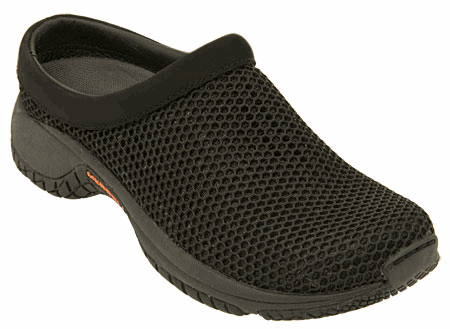
  • Try to get shoes that breathe. You can find shoes that are like clogs in their design, but are made of materials that breathe. Examples include Merrell’s Encore Breeze (my current personal preference). They are not only comfortable, but they can be put in the washing machine (minus the insoles) if they get really dirty at work.


Long days standing at work also make for stinky feet. Just like long-distance runners, you have to learn some tricks to deal with this.
  1. Have more than one pair of good shoes and alternate them.
  2. Don’t buy cheap socks. Wicking socks like Balega socks are worth the price.
  3. Take an extra pair of socks with you for long days and change them in the middle of the day.

Foot massage, pedicures, and other foot care

After work, in terms of “bang for the buck” there is nothing that will make you feel better than a little attention to your tired feet.

Use a good foot scrub in the bath or shower like Bath and Body Toe the Line of The Body Shop’s peppermint scrub .

Take 10 minutes and try some methods to soothe tired feet. If you are lucky enough to have a significant other who will rub your feet … congratulations! (and, by the way, it really is “true love”…)


Even if you are a guy – don’t blow off pedicures. If you’ve had one… you know. If you haven’t… try it before you decide.

Cross-posted on August 14, 2011 at wellnessrounds.org

What shoes do you wear around the hospital? How do you take care of yourself after being on your feet all day? We would love to know. Share with us in the comments below!

~~~

Mary L. Brandt, M.D. is a professor of Surgery, Pediatrics, and Medical Ethics at Baylor College of Medicine and a practicing pediatric surgeon at Texas Children’s Hospital. She is involved in education on a day-to-day basis in her clinical work. She also thinks about medical education on a bigger scale through her work as Vice Chair of Education of the Michael E. DeBakey Department of Surgery and Associate Dean of Student Affairs at Baylor College of Medicine. She is an active participant in the blog-o-sphere and on Twitter

Friday, July 19, 2013

AWS Pocket Mentor Now Available as E-book


Our most popular resource is now available as an e-book.
 Download your free copy on iTunes.


Description

The Association of Women Surgeons Pocket Mentor is a manual for surgical interns and residents. It is based upon the experiences of a number of women surgeons, and is intended to make your passage a bit easier than it was for many of them. This book provides a background of practical information that should make your residency less confusing, and thereby more rewarding.
 
Screenshots


This version of the AWS Pocket Mentor was made possible by support from Covidien.

Friday, July 12, 2013

Blogger Q & A: Advice passed down from our mentors


Every once in a while, we'll invite our bloggers to answer a question that's either been submitted by one of our readers or is something that a fellow blogger has been burning to have answered. Keep reading to find out our responses to the following question: 

What is the best advice you have been given by a mentor?

Callie: 1. When you are a junior resident, always ask your attendings and senior residents for their expectations at the outset and check in with them regularly to identify areas for improvement. As a senior resident, you will be less frustrated with your team if you let them know your expectations in the beginning. 2. Every bit of feedback will have a kernel of truth in it that you can use to improve yourself, no matter how small it is, take it and get better. Throw out the rest and never take it personally. (I admit this is totally easier said than done but I truly try to remember it every time I receive feedback.)

Jane: When you find yourself in a bind, ask yourself "What is best for my patient?" and you will rarely ever be led astray. Seek help when you need it, but treat each patient encounter as if you are your patient's one and only resource. For example, if your patient needs a scan or labs drawn immediately, stay by the patient's side, and make sure that happens! You can't predict when everything will turn out okay or if something will go awry, so never cut corners. Approach each patient systematically, starting with a broad differential diagnosis. Whatever you do, make sure you have good reasons to back it up. Read up regularly on all of your patients, always be honest, and remember that a little kindness and tact can go a long way.

Lauren: Be fearless. When given the opportunity, talk to everyone and anyone you can. You never know what value the connections you make now may have later on. This way, when you get to the point in your career when you are applying for fellowship or a job, everyone will already know who you are and you will be the obvious candidate for the position.

Minerva: Stay balanced. This is one piece of advice that has come in one way or another from multiple mentors both in and out of medicine/surgery. The truth is that staying balanced requires a lot of insight into yourself and the career we have chosen. Realizing that surgery can consume you 24/7 if you let it is one of the best ways to protect your personal life. The multiple key points to remember range from finding one thing daily that I can do for myself, to keeping up with one hobby, making time for family and loved ones, or just having something to help blow stress away. Ultimately an unhappy surgeon can make others around him/her just as miserable!

Sophia: “Focus on learning, not performance.” As a medical student, it can be easy to feel that you are constantly being scrutinized and evaluated. A mentor once told me to focus on learning instead of performance, meaning that I should act in ways that maximize my own growth rather than minimizing looking stupid. I felt liberated to ask questions that might seem too basic, and it made it easier to ask my superiors for feedback, help, and guidance. Focusing on growth also gave me a more positive attitude towards work: rather than thinking of tasks or notes as chores, I viewed them as opportunities to get better and learn something. I volunteered to take on more responsibilities as a way to learn more. Of course I made mistakes along the way, but instead of feeling like failures, mistakes felt like chances to learn how not to do something or a chance to try something again. Even though it is still difficult to hear criticism, I now make a conscious effort to change and demonstrate that I am responsive to negative feedback. What is so great about this advice is that in the end, my performance actually does improve as I focus on learning because I am constantly striving to increase my abilities and knowledge.

Do you agree with the advice that we've been given? What are some tidbits handed down to you by your mentors that you'd like to add? What questions would you like for our bloggers to address in a similar fashion in the future?

Thursday, July 4, 2013

Policy & Advocacy Corner: A Day on Capitol Hill

Happy Independence Day to our US readers! As a special holiday treat, today's blog post features an article from our members-only newsletter: AWS Connections. Enjoy!

My Day on the Hill


by Leigh Neumayer MD, FACS

In April 2013 I participated for the first time in one of the ACS Advocacy Summits in Washington, DC. Now I will admit, this was not something that was on my bucket list, but as a leader in the ACS, I was strongly encouraged to attend. In retrospect, I wish I would have started attending these summits years ago. Clearly the surgeons who had done this before were way more comfortable and polished in this role than I was. That being said, even if I was the only surgeon from my state there, I am confident the ACS Washington office would have prepared me well to fly solo.

After some prep work, reviewing the issues and with talks from some elected officials and their staff, we headed to Capitol Hill. What struck me initially was the sheer volume of U.S. citizens (usually in groups with nametags identifying the sponsoring organization) who were wandering the hallways of the Senate and Congressional office buildings with us. If we aren't there presenting our concerns and viewpoints, our elected officials' schedules will clearly be completely filled with other groups. Having not voted for several of the Utah delegation, it felt a bit weird visiting their offices. I had to remind myself that despite their party affiliation or who they defeated, these individuals (all men in the case of Utah) are now in Washington representing all of Utah, regardless of party. We had specific issues we were to review in each senator's/congressman's office. The Boston marathon bombings occurred the day before our visit, making funding for trauma systems an easy opening issue. From there we (my colleagues Dr. Amalia Cochran and Dr. Mark Savarise, both veterans in advocacy efforts) were able to cover a couple other issues. For each issue we had talking points and had made a plan about who was going to take the lead for each meeting. 

While we met with staff for the majority of the Utah senators and representatives, one of our senators was able to drop in at the end of the meeting and we were meeting with one of the representative's chief-of-staff in his office when he came by to pick up the rest of his lunch. We were given important tips along the way, like asking the staff of one representative to take us on a tour and the staff of another to deliver us underground from one building to another.

Overall, it was a great experience, one that I hope becomes habit for me. We live in a great country, and should take advantage of the privileges that are afforded us by citizenship, which includes making our voices heard in a constructive manner to those who can make a difference on a national level.
 
~~~

For more great stories like Dr. Neumayer's, join the Association of Women Surgeons today! A subscription to our quarterly newsletter is one of the many perks that our members enjoy. Visit our website to learn more about the Association of Women Surgeons and our membership benefits.